
On Kobo Daishi Kukai
CREATED: 2026 / 08 / 14 Fri
UPDATED: 2026 / 08 / 14 Fri
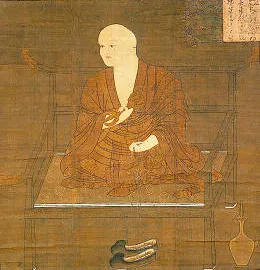
A portrait of Kukai. He holds a vajra in his right hand and a rosary in his left.
A Brief Life of Kukai
Kukai was born in Sanuki in the 5th year of Hoki (774 CE), and his given name was Saeki no Mao. At the age of 18 he went up to the capital and entered the training institution for government officials (there seems to be a story that he got in through the connections of an uncle on his mother’s side), but he quit the following year. The teachings of the ancients were nothing but dregs, and there was no benefit in studying such things superficially — with that sort of attitude he walked out of the university and, as a self-ordained monk, began ascetic training in the mountains and forests.
What I study is the dregs of the ancients. It brings no benefit even now before my eyes, let alone after this body falls. This flesh will rot away. Better to look up to the truth.

Shinzei, "Kukai Sozu Den"
Exactly what he did during that mountain training is not clear, but he appears to have practiced the Kokuzo Gumonji-ho, a discipline for attaining ultimate wisdom. Later, at the age of 24, he criticized Confucianism in his work “Rokogo Shiiki”, which he subsequently revised into the completed “Sango Shiiki”. “Sango Shiiki” is unusual in being written as a dialogue among fictional characters — it calls to mind Plato’s “Symposium” or Oscar Wilde’s “The Critic as Artist” — and it is striking that such a form of expression was already being used in 8th-century Japan.
Around the age of 31 (Enryaku 23, 804 CE), Saeki no Mao took the tonsure and began calling himself Kukai. Various reasons for his ordination have apparently been proposed — that he was imitating the life of Shakyamuni, or that it was in order to travel to Tang China. That same year he entered Tang as a student monk. Saicho was also aboard the fleet bound for Tang at that time. Kukai studied abroad at his own expense, while Saicho crossed to Tang on state funds. In that sense Saicho was very much a member of the elite. Tachibana no Hayanari, who along with Kukai and Emperor Saga is counted among the Sanpitsu (the “Three Brushes”), also crossed to Tang with Kukai and Saicho at this time.
In Chang’an, the Tang capital, Kukai studied under a monk named Huiguo at Qinglong Temple. There he received the denpo kanjo (the ritual of inheriting the esoteric teachings and attaining the rank of acharya) of both divisions of esoteric Buddhism (the Womb Realm and the Diamond Realm — the esoteric view of the world). Huiguo conferred on Kukai the initiation name Henjo Kongo.
After the denpo kanjo, Huiguo passed away and Kukai also found himself in financial difficulty, so he returned home from Tang. Getting back from Tang was not a simple matter, however. He was extremely lucky: there happened to be a ship returning to Japan, which was the only reason he could go home. Had the timing been worse, he would have been unable to return to Japan for over 30 years. In any case, he returned from Tang in 806 (Daido 1) and stayed at Dazaifu. In 809 (Daido 4) he was permitted to return to the capital, and he compiled the “Goshorai Mokuroku” (essentially a report) and submitted it to the court of the time.
Though Kukai's offense of overstaying his term is more than plain to see, he privately rejoices — that he has lived to bring back a teaching so hard to obtain.

"Goshorai Mokuroku"
This is how Kukai brought systematic esoteric Buddhism to Japan for the first time (esoteric Buddhism itself had entered Japan before this). Afterward he took up residence as abbot of Takaosan-ji (now Jingo-ji in Umegahata Takao-cho, Ukyo-ku, Kyoto) and came to associate with Saicho as well.
His life from then on runs as follows. In 816 (Konin 7), Emperor Saga granted Mount Koya to Kukai by imperial decree. Kukai established a training hall for meditation on Mount Koya. In 821 (Konin 12), Kukai repaired Manno Pond in Manno Town, Kagawa Prefecture — one of the largest reservoirs in Japan — making full use of the civil engineering techniques he had learned in the east. In 823 (Konin 14), Emperor Saga granted To-ji to Kukai by imperial decree. In 828 (Tencho 5), Kukai founded the Shugei Shuchi-in, Japan’s first educational institution for commoners. In 834 (Jowa 1), imperial permission was granted for the Goshichinichi Mishiho that Kukai had petitioned for.
Then, in 835 (Jowa 2), Kukai entered nyujo (died) on Mount Koya. Yet a legend persisted that Kukai went on living afterward, and this was carried forward as the nyujo faith surrounding him. In 1023 (Chian 3), Fujiwara no Michinaga composed the following poem.
How blessed it is — in the shadow of the rocks of Mount Koya, the Great Master is said to dwell there still.

Fujiwara no Michinaga
In 921 (Engi 21), Emperor Daigo bestowed on Kukai the posthumous title of Kobo Daishi. After this, faith in Kobo Daishi spread throughout the country.
The Goshichinichi Mishiho
Incidentally, the Goshichinichi Mishiho is still performed today. Its contents are not normally made public, but footage of it was shown at “Kukai and the Treasures of Shingon”, held at the Tokyo National Museum from July 14 to September 6, 2026.
The Goshichinichi Mishiho is a rite in which the emperor’s robe is consecrated and prayers are offered for the well-being of the imperial person and for abundant harvests. It is overseen by the Shingon-shu Kakuha Sodaihonzan-kai (the Kakuzan-kai, made up of 18 Shingon temples), and is conducted with the Dai-Ajari — the highest officiant, chosen from among those temples — at its center. Each year, after Shinto rites are performed from New Year’s Day through the 7th, it is held at To-ji in Kyoto from the 8th through the 14th.
Closing Notes
The sheer force of Kaikei’s standing statues of Shukongoshin and Jinja Daisho, on display at “Kukai and the Treasures of Shingon” (Tokyo National Museum, July 14 – September 6, 2026), was tremendous.
There isn’t much time left, but if you’re interested, do go and see it.
Come to think of it, the site where the Tokyo National Museum now stands was apparently once the grounds of Toeizan Kanei-ji, the head temple of the Tendai sect in the Kanto region. Kanei-ji seems to have been built on land forming the kimon (demon gate) of Edo Castle during the reign of the second shogun, Tokugawa Hidetada.
In the 2nd year of Kanei (1625), it was founded by the High Priest Tenkai, Jigen Daishi, on the Ueno plateau — the kimon (northeast) of Edo Castle — to pray for the stability of the Tokugawa shogunate and the peace of all the people.

See the reference material "About Kanei-ji"
In other words, an exhibition on Kukai of the Shingon sect is being held on land belonging to that Tendai sect. Given that Shingon and Tendai were at odds during the Heian period, it’s a rather amusing thought.
References
The Birth and History of Kobo Daishi
Tokyo National Museum: History of the Museum
About Kanei-ji